Class -10 chapter – 4, Quadratic Equations, Quick Ways to Solve Quadratic Equation Word Problems Class 10, Simple Steps to Solve Quadratic Equations (Chapter 4), Most Important Quadratic Equation formula for Class 10 Board Exam,
(A) What is a quadratic equation?/ What are the properties of a quadratic equation?/ Which equation will be considered as a quadratic equation?
An equation will be considered as a quadratic equation if and only if;
(i) The degree of the equation is 2.
(ii) Number of variables should be equal to or more than 1.
(iii) If there is only variable, it will be an equation of parabola.
(iv) If there are two variables, it will be an equation of ellipse.
(v) A quadratic equation having three variables will represent a 3 dimensional shaped figure.
(vi) The general form of a quadratic equation (as per the syllabus of class 10) is ax2+bx+c=0,where a must not be equal to 0. Because if it happens, then below facts will be visible;
(a) The term related to ax2 will be zero.
(b) Due to the absence of ax2 the quadratic equation ax2+bx+c=0 is reduced to a linear equation bx+c=0.It will be a linear equation in one variable.
(B) Method of finding Common Elements./ How to exclude common terms from an equation or expression?
Method of finding Common Element is a technique to convert a given expression/polynomial into the product of two expressions or polynomials. Following steps are involved in this process. With help of which, this process will become easy to understand:
Step -1
(a) Convert each term of the given expression/polynomial/equation in the product of its elements.
(b) If there are numbers in terms, then convert those numbers in the product of its prime factors.
Step -2
(a) Take the element out which is present in all terms keeping the rest in a bracket with proper sign convention.
(b) But the main condition is that the specific element (present in all terms) will not be present this time inside the bracket.
A better understanding will be developed by example regarding the above process. So we are going to take an expression 9x2+12xy.
Step -1
In this step, we will convert the given expression into the product of its element.
Therefore,
9x2+12xy
= 1×3×3×(x)×(x) + 1×2×2×3×(x)×(y)
Here,1, 3 and x are common elements in both the terms.
Step -2
In this step, we will take common elements out.
Hence,
9x2+12xy
= 1×3×3×(x)×(x) + 1×2×2×3×(x)×(y)
= 1×3×(x)×{3×(x)+2×2×(y)}
= (3x) (3x+4y)
In this way the expression 9x2+12xy can be converted into the product of two expressions.
(C) Methods of solving a Quadratic Equation:
There are many methods of solving a quadratic equation which are as follows:
(1) Discriminant Method or Method of Quadratic Formula
(2) Factorization Method
(1) Discriminant Method or Method of Quadratic Formula:
(a) This is the best method for solving a quadratic equation.
(b) In a special case, when we become failed to solve a given quadratic equation, this method will hit the equation by an arrow and result the perfect solution.
(c) Roots of a quadratic equation are nothing but values of the variable (used in the equation) which satisfy the given quadratic equation.
(d) We know that if there is a single variable in a particular equation then
Number of degree = Number of values of variables
(e) Since, a specific quadratic equation has single variable and degree two.
Therefore,
Number of roots of equation
= Number of values of variable
= Number of degree of equation
= 2
With help of following steps, we will be able to implement this method easily. Suppose a quadratic equation is ax2+bx+c=0 where
Coefficient of x2 = a
Coefficient of x = b
Constant Term = c
Also let α and β are two roots of ax2+bx+c=0
Step−1
First of all, write down the Coefficient of x2, Coefficient of x, and constant term separately.
Step−2
In this step, obtain the value of ‘D’ which is basically
D (Discriminant)
= (Coefficient of x)2–4×(Coefficient of x2)×(Constant Term)
=b2–4×a×c
=b2–4ac
Step−3
In this step, we will try to get two values of the quadratic equation with help of the two given formulae:
α = {–b +√(b2–4ac)}/2a and
β = {–b–√(b2–4ac)}/2a
Nature of roots of a quadratic equation
Let us consider a quadratic equation ax2+bx+c=0, the discriminant of which is as follows;
D (Discriminant)=b2–4ac
Based on the value of D (discriminant) we can say that what will be the nature of roots of the given quadratic equation. On the basis of the below table we can understand different conditions related to the nature of roots which can be determined by the value of the discriminant.
| Value of D | Nature of roots |
| (i) If D > 0 i.e. if D is greater than zero. | There will be two roots and value of both roots will be real numbers and different. |
| (ii) If D = 0 i.e. if D is equal to zero. | Again there will be two roots but this time values of both roots will be same and real. |
| (iii) If D < 0 i.e. if D is less than zero or we can say that value of D is negative. | In this case, definitely there will be two roots again but both roots will be imaginary and not will be real. |
N.B. (Note Book)
(a) The value of discriminant plays an important role in understanding the nature of roots without solving the equation.
(b) Two formulae α = {–b +√(b2–4ac)}/2a and β = {–b–√(b2–4ac)}/2a for finding roots of a given quadratic equation are also called quadratic formulae.
(c) Everything is same but there is a slight difference between the formulae of α and β i.e. in the formula of α, there is an addition operator in between (–b) and (√(b2–4ac) while in the formula of β, there is subtraction operator in between (–b) and (√(b2–4ac).
(d) In 1st and 2nd cases, the D is greater than and equal to zero respectively. It means that value of D is a non-negative number the square root of which can be calculated by normal method.
(e) In the 3rd case of the above table, if D < 0, the nature of roots will be imaginary because of following reasons;
D < 0
i.e. b2–4ac<0
i.e. (b2 – 4ac) will be a negative number.
i.e. Roots of a quadratic equation will be {–b +√–(b2–4ac)}/2a and {–b –√–(b2–4ac)}/2a respectively.
We know that square root of any negative number cannot be calculated by simple method. It is obtained by method related to complex number.
Example:- Find roots of a quadratic equation ax2–5x+6=0.
Step−1
In our 1st step we will take constant term along with coefficients of x2 and x respectively out.
Coefficient of x2 = 1
Coefficient of x = (–5)
Constant Term = 6
Step−2
In this step, we will try to evaluate the value of D using the formula D=b2–4ac.
D (Discriminant)
= (Coefficient of x)2–4×(Coefficient of x2)×(Constant Term)
=b2–4×a×c
=(–5)2–4×1×6
=25–24
=1
Step−3
In this step, we will try to obtain 1st root of the given quadratic equation on the basis of quadratic formula.
α (1st root)
= {–b +√(b2–4ac)}/2a
= {–b +√D}/2a
= {–(–5) +√1}/(2×1)
= {5 +1}/2
= 6/2
= 3
Step−4
In this step, 2nd root of the given equation will be tried to be evaluated by using the quadratic formula;
β (2nd root)
= {–b –√(b2–4ac)}/2a
= {–b –√D}/2a
= {–(–5) –√1}/(2×1)
= {5 –1}/2
= 4/2
= 2
In this way, hence,, two required roots are 3 and 2 respectively.
(2) Factorization Method
(a) This is another method to solve a given Quadratic equation.
(b) The main concept of this method is to convert the LHS of the quadratic equation into the product of two linear polynomials.
(c) We need to use the process of taking common element at two stages.
(d) We are going to consider the general form of a quadratic equation as ax2+bx+c=0 in which constant term along with coefficients of x2 and x are c, a and b respectively.
(e) The following steps will be useful to understand this method:
Step−1
Multiply a and c.
Step−2
Get prime factors of the product of a and c.
Step−3
(i) Make two groups of factors obtained in the 2nd step such that:
(a) The result obtained by addition or subtraction process in between the two groups of factors of the product of a and c should be equal to b.
(b) The product of two groups of factors should be equal to the product of a and c.
(ii) In this way now, there will be four terms with proper sign convention.
(a) One term related to x2.
(b) Two terms related to x.
(c) One constant term.
(iii) It is essential to take into our mind that although 1 is not prime number, it will be also included in the group of factors.
Step−4
In this step we we apply the process of taking common for the 1st time in between following things but the main condition is that expression inside both the bracket after taking common element out must be same.
(a) term related to x2 and one term related to x and
(b) another term related to x and constant term.
Step−5
(a) Now the process of taking common will be implemented for the 2nd time.
(b) Take the same expression inside bracket out keeping rest elements inside another bracket.
Step−6
(a) Make two expressions inside two brackets developed in the 5th step equal to zero.
(b) In this way, two values of the variable will be obtained.
Example:- Find roots of a quadratic equation x2–5x+6=0 by using factorization method.
Step−1
Coefficient of x2 = 1 = a
Coefficient of x = (–5) = b
Constant Term = 6 = c
Therefore,
Product of a and c
= a×c
= 1× 6
= 6
Step−2
In this step we will convert product a and c i.e. 6 into product of its prime factors.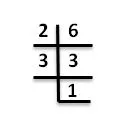
Therefore,
Product of a and c
= a×c
= 6
= 1 × 2 × 3
In this manner, we have three basic factors i.e.1, 2 and 3.
Step−3
(i) Now we will try to make two groups of all the factors obtained in 2nd step such that:
(a) Combination of {by (+) or by (–)} two groups should be equal to b.
(b) Multiplication of two groups should be equal to ac.
(ii) For achieving above goal, we will use the hit and trial method.
(iii) In only two cases our desired result of groups is expected which are given below:
(a) (1×2) and 3 or,2 and 3
(b) (1×3) and 2 or,3 and 2
(iii) Since both cases indicate same numbers 2 and 3. So we can consider either of the two cases.
Step−4
Now we will try to use the two groups developed in our 3rd step in the given equation.
Therefore,
x2 – 5x + 6 =0
x2 –2x –3x + 6 = 0
Step−5
In this step, we will apply the process of taking common element for the very first time by keeping a fact in our mind that expressions inside both the bracket must be the same.
Hence,
x2 – 5x + 6 =0
x2 –2x –3x + 6 = 0
(x)×(x) –1×2×(x)–1×3×(x)+1×2×3 = 0
x(x–1×2)–3{1×(x)–1×2} = 0
x(x–2)–3(x–2) = 0
Step−6
Now we will apply the process of taking common for the 2nd time.
In this way, expression on the left hand side (LHS) of the given equation will be splitted into the product of two new expressions.
Therefore,
x2 – 5x + 6 =0
x2 –2x –3x + 6 = 0
(x)×(x) –1×2×(x)–1×3×(x)+1×2×3 = 0
x(x–1×2)–3{1×(x)–1×2} = 0
x(x–2)–3(x–2) = 0
(x–2)(x–3) = 0
Step−7
Now we will make two expressions obtained in our 6th step equal to zero.
Therefore,
| x – 2 = 0 | x – 3 = 0 |
| or, x = 0 + 2 | or, x = 0 + 3 |
| or, x = 2 | or, x = 3 |
Thus, the required roots of the given quadratic equation x2 – 5x + 6 =0 are 2 and 3 respectively.