Similar Triangles Application-Based Sums: Poles and Shadows; Area of Similar Triangles: Ratio of Corresponding Sides; Basic Proportionality Theorem (BPT) Tricks & Problems; Constructing a Triangle Similar to a Given Triangle
Similarity is an interesting topic but the lack of exact approach towards questions makes this topic and related questions hard to understand. Keeping this issue in mind, we are going to understand the similarity in a very easy way. So let’s start with the definition of the similarity.
(A) Difference between congruency and the similarity/Difference Between Similar and Congruent Triangles Class 10/ Similar Triangles vs Congruent Triangles
(1) Basically pattern of solving questions of both chapters is same.
(2) But one fact makes the congruency and the similarity different.
(3) In case of congruency, the two figures will be identical in relation to shape and dimensions both.
(4) While in case of similarity, the shape of the two given figures will be same but the dimensions will be different.
(B) What is similarity? Similar Triangles Definition/ What is Similarity in Geometry? Similar Figures Definition and Examples
(1) In similarity; Shapes of the given figures should be same. The corresponding angles should be same. The ratio of corresponding sides should be same. This concept is summarized by a single word proportional. The symbol of similarity is “~“.
(2) We are going to deal with two equilateral triangles in relation to the similarity as described below:
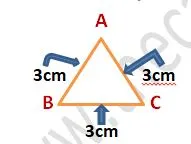
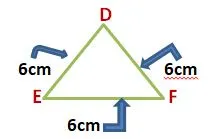
Condition – 1
Being equilateral triangles, each angle of both the triangles will be equal to 60 degree.
So the shape will be same which is the 1st criteria as per the definition of similarity. Now we going to concentrate on the ratio of corresponding sides which is the 2nd criteria.
Condition – 2
For analyzing the 2nd condition in both the figures, we are going to calculate the ratio of corresponding sides one by one.
Therefore, Length of side AB/Length of side DE
= 3/6
= 1/2 Length of side BC/Length of side EF
= 3/6
= 1/2 Length of side CA/Length of side FD
= 3/6
= 1/2
Since,
Length of side AB/Length of side DE=Length of side BC/Length of side EF=Length of side CA/Length of side FD=1/2
Hence the 2nd condition has also been fulfilled. And thus, Δ ABC ~ Δ DEF.
N.B.(Note Book)
(i) If corresponding angle is same, automatically the two figures will be similar.
(ii) Because an angle plays a vital role in the design of any figure or structure.
(iii) In simple words we can say that any design directly or indirectly depends upon the angle at different points inside the design.
(C) Different criteria of similarity of two Triangles/ Similar Triangles Criteria (AA, SAS, SSS) Examples/ How to Prove Two Triangles are Similar: Step-by-Step/ AA vs SAS vs SSS Similarity Rules Explained
There are some rules which if will be followed by the given figures; we can then conclude that the given figures are similar.
Following are the specific criterion which decide the similarity:
(a) AAA (Angle Angle Angle) criteria of similarity of two triangles,
(b) SSS (Side Side Side) criteria of similarity of two triangles,
(c) SAS (Side Angle Side) criteria of similarity of two triangles.
(a) AAA (Angle Angle Angle) criteria of similarity of two triangles
In the two given triangles, if corresponding angles are equal, then on the basis of A-A-A (Angle-Angle-Angle) criterion of similarity the two given triangles will be similar.
Let us consider two triangles Δ ABC and Δ DEF such that: ∠BAC = ∠EDF = 40 degree ∠ABC = ∠DEF = 70 degree ∠ACB = ∠DFE = 70 degree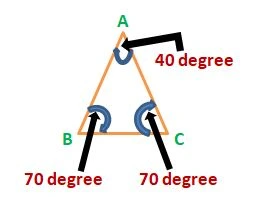
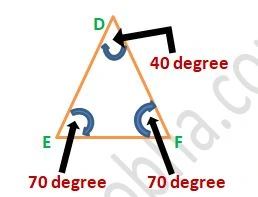
Therefore from the AAA (Angle Angle Angle) criteria of similarity of two triangles, the two triangles ΔABC and ΔDEF are similar.
(b) SSS (Side Side Side) criteria of similarity of two triangles
In the two given triangles, if corresponding sides are in the same ratio, then on the basis of SSS (Side Side Side) criterion of similarity the two given triangles will be similar.
Let us consider two triangles Δ ABC and Δ DEF such that: Length of side AB/Length of side DE
= 1/2 Length of side BC/Length of side EF
= 3/6
= 1/2 Length of side CA/Length of side FD
= 2/4
= 1/2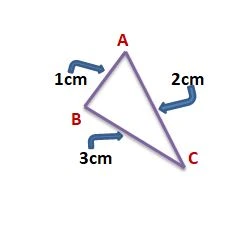
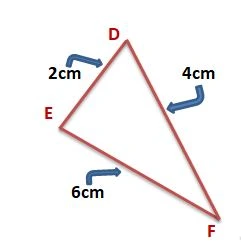
As ratio of corresponding sides is 1/2 i.e.
Length of side AB/Length of side DE=Length of side BC/Length of side EF=Length of side CA/Length of side FD=1/2
Therefore from the SSS (Side Side Side) criteria of similarity of two triangles, the two triangles ΔABC and ΔDEF are similar.
(c) SAS (Side Angle Side) criteria of similarity of two triangles
In the two given triangles, if one angle of the 1st triangle is equal to one angle of the 2nd triangle and corresponding sides associated to these angles are in the same ratio. Then the two given triangles will be similar on the basis of SAS (Side Angle Side) criterion of similarity.
Let us consider two triangles Δ ABC and Δ DEF such that: Angle ABC = Angle DEF = 70 degree Length of side AB/Length of side DE
= 3/6
= 1/2 Length of side BC/Length of side EF
= 2/4
= 1/2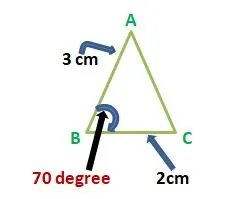
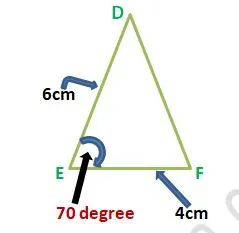
On the basis of SAS (Side Angle Side) criteria of similarity of two triangles, we can say that triangles ΔABC and ΔDEF are similar.
(D) Best way to solve the questions related to similarity/ How to solve similarity questions?/ Method of solving similarity questions with example
Concept is one thing and the implementation of the concept in the question is another thing. If we will utilize following techniques described in below steps in our question, definitely any question of the similarity will not be hard to solve from now.
So let’s start with an example. Let us consider two triangles Δ ABC and Δ DEF such that: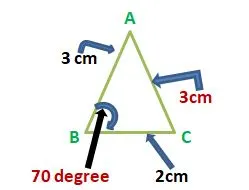
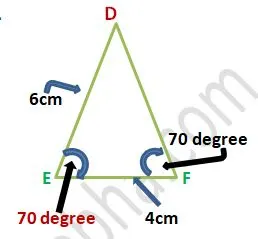
Step – 1
First of all we will write all the given information regarding the two triangles separately with full of the clarity.
| In triangle ABC | In triangle DEF |
| Angle B = 70 degree | Angle F = 70 degree |
| AC = 3cm | Angle E = 70 degree |
| AB = 3cm | DE = 6cm |
| BC = 2cm | EF = 4cm |
Step – 2
(1) Now we will take decision which of the following criteria will be applicable in the given situation
(a) AAA (Angle Angle Angle) criteria of similarity of two triangles,
(b) SSS (Side Side Side) criteria of similarity of two triangles,
(c) SAS (Side Angle Side) criteria of similarity of two triangles.AAA (Angle Angle Angle) criterion of similarity is not applicable because there is only one common angle which are ∠ABC and ∠DEF SSS (Side Side Side) criterion of similarity is also not applicable because only two corresponding sides are in the same ratio.
Length of side AB/Length of side DE = Length of side BC/Length of side EF = = 1/2 Now we have only one criterion remained because two rules have already been failed. The 3rd criteria will definitely be work which is SAS (Side Angle Side) criterion of similarity of two triangles.
Let’s try.
| In triangle ABC | In triangle DEF |
| AB = 3cm | DE = 6cm |
| Angle B = 70 degree | Angle E = 70 degree |
| BC = 2cm | EF = 4cm |
(2) Once the applicable criteria is confirmed then we will move towards the nomenclature of the two given triangle.
Step – 3
(i) It essential to incident light on one fact that nomenclature of the two given triangles is a very very important concept.
(ii) Without proper nomenclature, our all previous efforts done in 1st and 2nd steps will be useless.
(iii) So we are going to describe exact approach regarding proper nomenclature in different stages:
Stage – A
(a) We know that there are three letters of English alphabet in the name of any triangle.
(b) So, we will create three blank places for both triangles separately in the following ways:
| For triangle ABC | For triangle DEF |
 ,, ,, | ,, |
Stage – B
(a) First of all we will take any one specific angle the value of which is same in both the triangle.
(b) In the given example, we will consider ∠B and ∠E respectively because ∠ABC = ∠DEF = 70 degree
(c) Now will write the specific letters (associated with equal angles) at the 1st place for the both triangles.
| For triangle ABC | For triangle DEF |
| B, , | E,, |
Stage – C
(a) Now we will try to fill the 2nd vacant place. For this we will utilize the pre confirmed criteria.
(b) According to the criteria SAS, we have now two proportional sides because we have utilized the option of angle in our Stage – B.
(c) We can select any proportional side but the main condition is that selected sides must be proportional and it should be associated to condition of Stage – B.
(d) We are going to select the side BA in triangle ABC and corresponding side DE in triangle DEF.
(e) So in 2nd vacant places we need to fill A and D respectively for triangles ABC and DEF.
| For triangle ABC | For triangle DEF |
| B A, | E D, |
Stage – D
We will now write the remaining vertices in the 3rd vacant places respectively.
| For triangle ABC | For triangle DEF |
| B A C | E D F |
Therefore, Δ BAC is similar to the Δ EDF.
Step – 4
(1) In this step we will check whether work done in 2nd and 3rd steps is correct or not.
(2) As we have got the order of vertices in both the triangles, we will utilize this order of letters for matching the given conditions as:
(A) Letter at 1st position
Angle A = angle E ———————- it is given.
(B) Letters at 1st and 2nd positions and 1st and 3rd positions.
Length of side BA/Length of side ED = Length of side BC/Length of side EF —————- it is given.
Therefore our direction and result were correct.
Step – 5
In this step we will conclude some facts as triangle BAC is similar to the triangle EDF.
Hence, Angle B = angle E Angle A = angle D Angle C = angle F Length of side BA/Length of side ED=Length of side AC/Length of side DF=Length of side BC/Length of side EF
(E) The ratio of the areas of two similar triangles is equal to the square of the ratio of their corresponding sides
(1) If two triangles are similar then ratio of their areas will be equal to the square of the ratio of their corresponding sides.
(2) Suppose triangles Δ ABC and Δ DEF are similar as given below: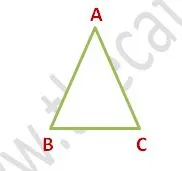
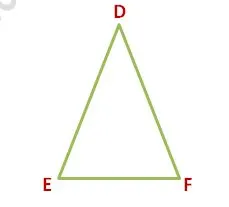
Then,
Area of Δ ABC/area of Δ DEF = (AB/DE)2 = (BC/EF)2 =(CA/FD)2
(F) The ratio of the perimeters of two similar triangles is equal to the ratio of their corresponding sides
(1) If two triangles are similar then ratio of their perimeters will be equal to the ratio of their corresponding sides.
(2) Suppose triangles Δ ABC and Δ DEF are similar as given below:
Then,
Perimeter of Δ ABC/ perimeter of Δ DEF = (AB/DE) = (BC/EF) =(CA/FD)