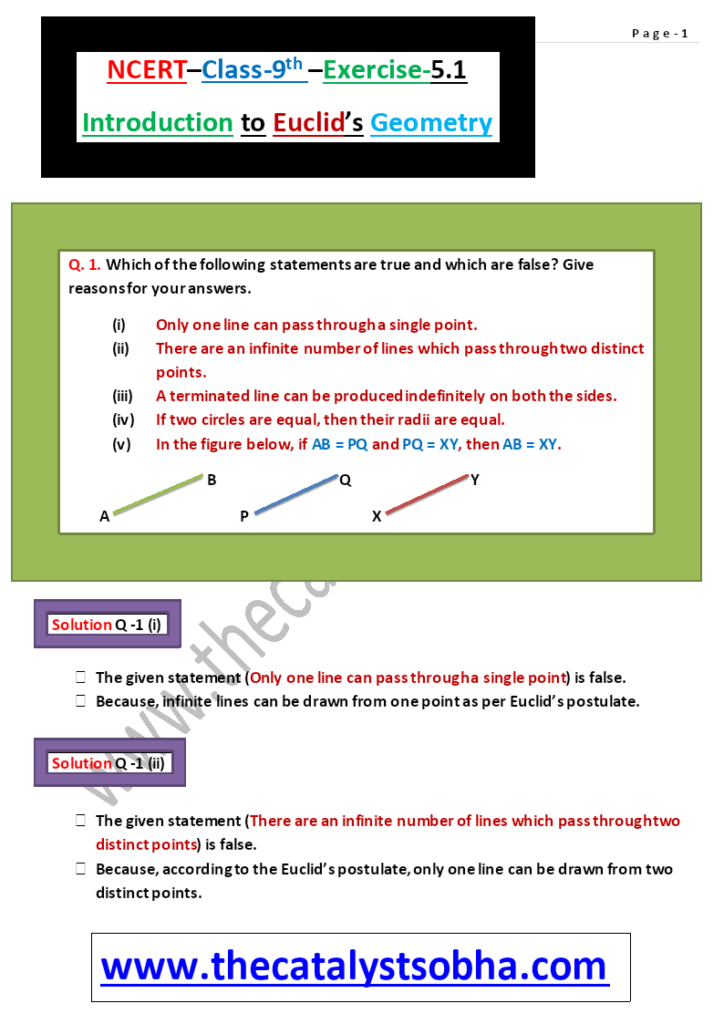
Q. 1. Which of the following statements are true and which are false? Give reasons for your answers
(i) Only one line can pass through a single point.
(ii) There are an infinite number of lines which pass through two distinct points.
(iii) A terminated line can be produced indefinitely on both the sides.
(iv) If two circles are equal, then their radii are equal.
(v) In the figure below, if AB = PQ and PQ = XY, then AB = XY.
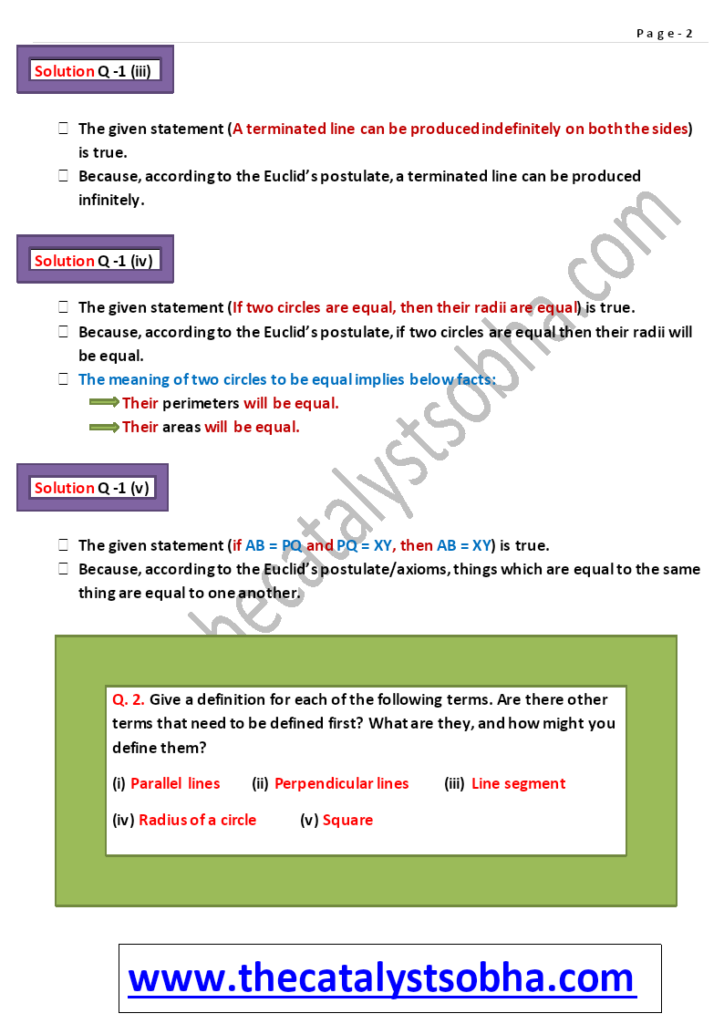
Q. 2. Give a definition for each of the following terms. Are there other terms that need to be defined first? What are they, and how might you define them?
(i) Parallel lines, (ii) Perpendicular lines (iii) Line segment
(iv) Radius of a circle (v) Square


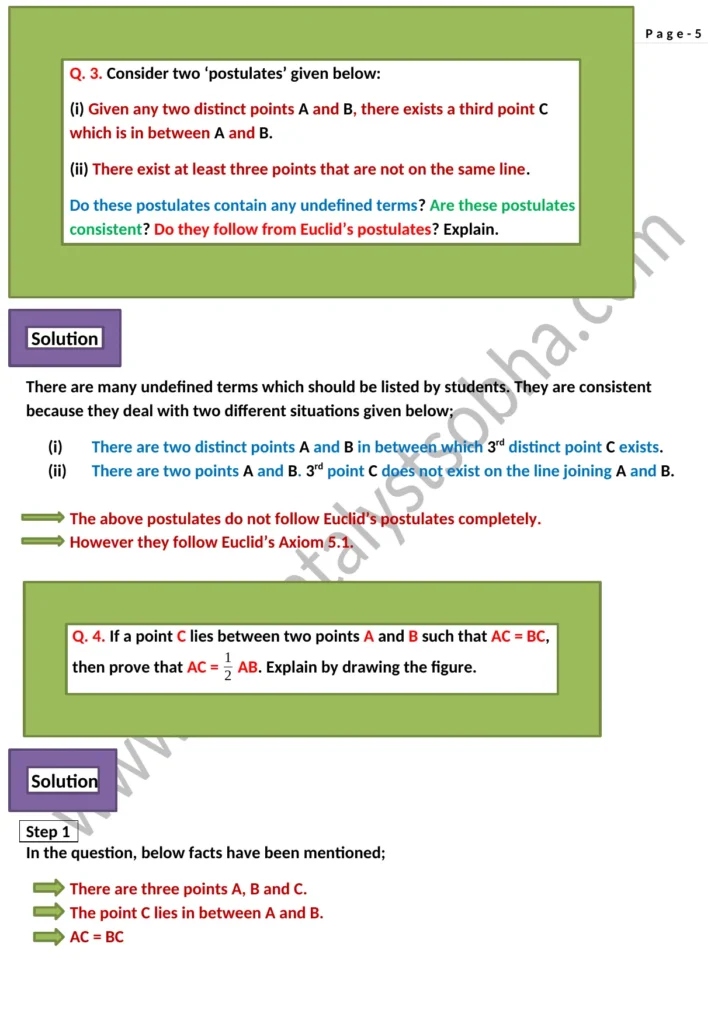
Q. 3. Consider two ‘postulates’ given below:
(i) Given any two distinct points A and B, there exists a third point C which is in between A and B.
(ii) There exist at least three points that are not on the same line.
Do these postulates contain any undefined terms? Are these postulates consistent? Do they follow from Euclid’s postulates? Explain.
Q. 4. If a point C lies between two points A and B such that AC = BC, then prove that AC = AB/2. Explain by drawing the figure.
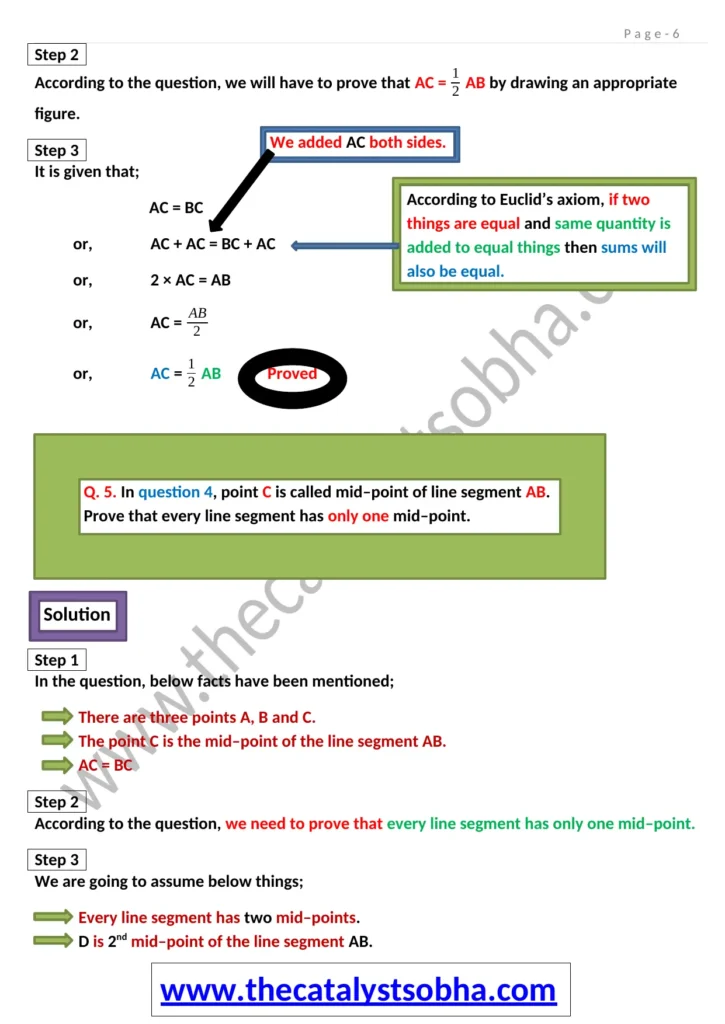
Q. 5. In question 4, point C is called mid–point of line segment AB. Prove that every line segment has only one mid–point.
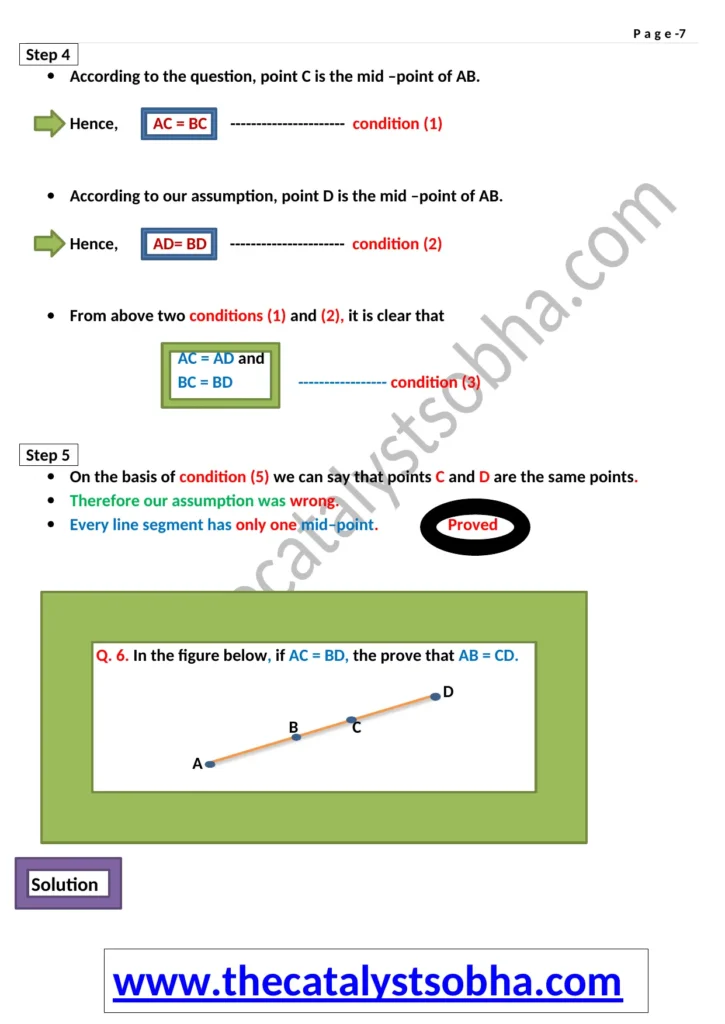
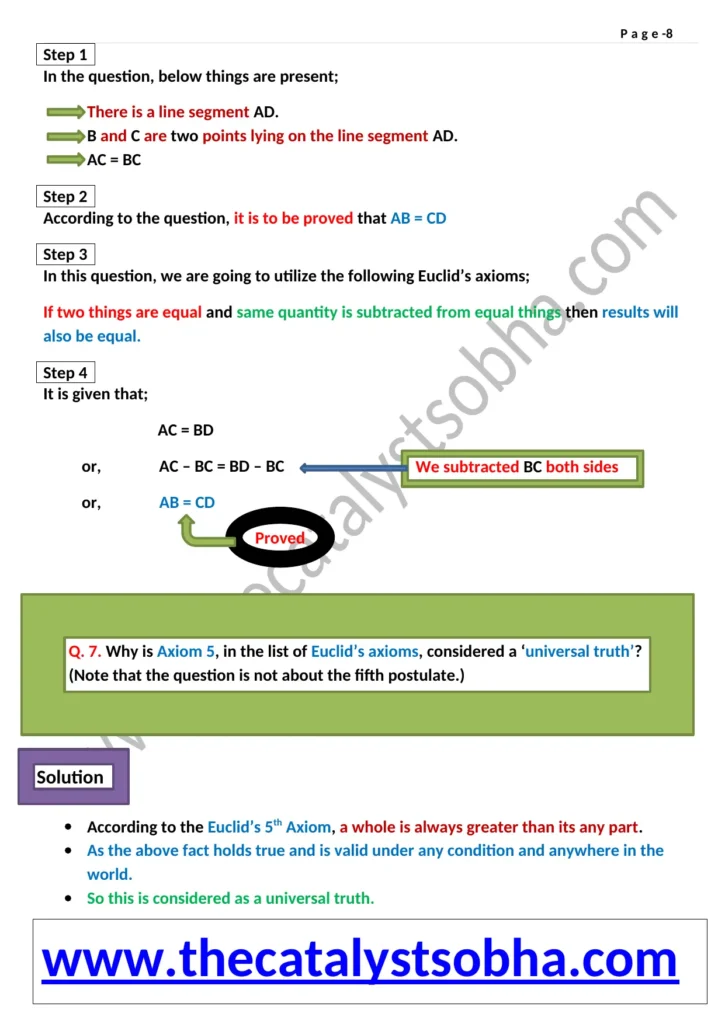
Q. 6. In the figure below, if AC = BD, the prove that AB = CD.
Q. 7. Why is Axiom 5, in the list of Euclid’s axioms, considered a ‘universal truth’? (Note that the question is not about the fifth postulate.)